All Day Stock in 15 Minutes: Chef Chris Young and James Hoffmann Reinvent the Kitchen Staple
Chef Chris Young and coffee expert James Hoffmann present a revolutionary method for making rich stock in just 15 minutes using ground meat and a blender, challenging traditional cooking techniques.
Making a classic, rich stock usually means roasting heavy bones for hours and tending a simmering pot all day. In his latest video, culinary scientist Chris Young throws out the rulebook to prove you can achieve identical depth in just 15 minutes using ground meat, a blender, and a single egg.
The Science Behind the 15 Minute Stock
Young argues that great stock should taste of meat rather than bones. Ground meat offers more than ten times the surface area for browning and five times the natural sugars and amino acids needed to trigger the Maillard reaction compared to bones.
His rapid method follows four clear stages:
High Heat Browning: Shallow frying a block of ground veal like a steak creates deep colour before breaking the meat up, preventing trapped juices from boiling the pan.
Replacing Collagen: Because ground meat lacks bone collagen, Young stirs a 7g packet of powdered gelatine into half a litre of water alongside thinly sliced mirepoix to build body.
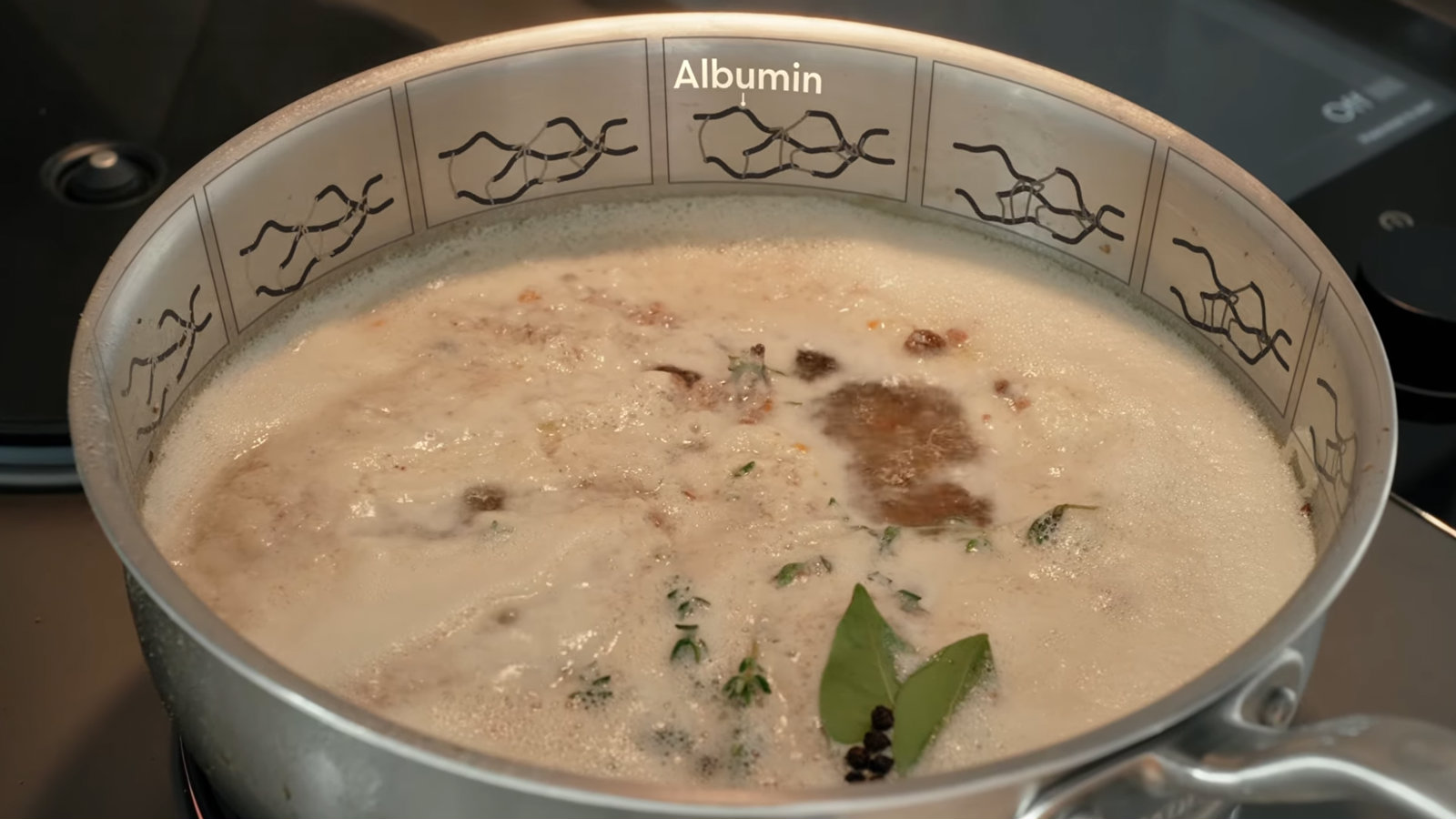
Cavitation Extraction: Blending the simmered mixture with one raw egg white and cold water uses intense shear force to shred the meat into tiny particles while whipping air into the albumin proteins.
Rapid Clarification: Returning the mixture to a simmer causes the egg white proteins to trap fat droplets and solids, floating them to the top as a solid raft that strains cleanly through a coffee filter.
---
Recipe Card: Chris Young's 15 Minute Boneless Veal Stock
Prep Time: 5 minutes
Cook Time: 10 minutes
Total Time: 15 minutes
Yield: Approximately 1 litre
Ingredients
* Ground veal (or beef/chicken mince)
* Neutral cooking oil, for shallow frying
* Thinly sliced mirepoix (onion, carrot, and celery, using a smaller ratio than traditional stock so vegetable notes do not overpower the meat)
* 7g powdered gelatine (1 standard sachet)
* 1 litre cold water, divided into two 500ml portions
* 1 large egg white (yolk discarded or saved for another dish)
* Fresh thyme sprigs
* Bay leaves
* Whole black peppercorns
Method
- Heat a generous layer of neutral oil in a heavy pot over high heat. Place the block of ground meat in whole like a steak and brown deeply on both sides before breaking it up into smaller pieces.
- Pour off all excess cooking fat and return the browned meat to the pot.
- Add the thinly sliced mirepoix and brown alongside the meat juices to develop a rich fond on the base of the pot.
- Sprinkle in the 7g sachet of gelatine and pour in 500ml of water to deglaze the pan. Bring the mixture to a brisk simmer.
- Add the egg white and the remaining 500ml of cold water to a high powered blender. Blend on high speed briefly to shear the albumin proteins and whip in tiny air bubbles.
- Pour the hot simmered meat and vegetable mixture into the blender. Blend on a low speed just until the solids break down into small particles and the liquid turns murky. Do not blend into a smooth puree.
- Return the mixture to the pot, add the fresh thyme, bay leaves, and peppercorns, and bring back to a simmer.
- Cover with a lid and simmer briefly so the egg white coagulates into a firm floating raft that traps fat and suspended solids.
- Pour the stock through a paper coffee filter or thick kitchen paper lined sieve into a clean jug. Reduce by three quarters to four fifths to create a rich demi glace if making pan sauces.
---
A book to explore

Modernist Cuisine:The Art and Science of Cooking: The Art & Science of Cooking
By Nathan Myhrvold, Chris Young, Maxime Bilet
View book at Bookshop.orgClassic Sauces and One Minute Bouillon
With the stock reduced into a glossy demi glace, Young demonstrates its versatility across two French classics. First comes a sharp Cognac and cream peppercorn sauce for hanger steak, followed by a rich red wine and port reduction built for a holiday roast.
For cooks wanting even greater speed, Young dehydrates browned ground meat and vegetables overnight at 93°C (200°F) before grinding them into a savoury powder. To master the extraction, he recruits British coffee expert James Hoffmann. Testing coffee brewing gear at a five to one water ratio, they discover two distinct results:
- French Press: A four minute steep yields a heavy, full bodied broth ideal for rustic soups and stews.
- V60 Pour Over: Pulsed water pours through a paper filter produce a crystal clear, vibrant consommé.
---
Recipe Card: One Minute Homemade Bouillon Powder
Prep Time: 10 minutes
Cook Time: 1 hour roasting plus overnight dehydration
Brew Time: 1 to 4 minutes
Brew Ratio: 1 part powder to 5 parts boiling water (50g powder to 250g water per mug)
Ingredients
* Ground veal (or beef/chicken mince)
* Thinly sliced mirepoix (onion, carrot, and celery)
* Dried thyme
* Dried parsley
* Fine sea salt, to taste
* Pinch of MSG (monosodium glutamate), to enhance savoury depth
Method
- Place the raw ground meat and thinly sliced mirepoix directly into the base of a dry ovenproof pot or roasting tray.
- Roast in an oven at 200°C (400°F) for roughly 1 hour, stirring every 15 minutes until deeply browned without burning.
- Reduce the oven temperature to 93°C (200°F) and leave overnight until completely dry, brittle, and crumbly.
- Transfer the dried mixture to a spice grinder or high speed blender and blitz into a coarse powder resembling ground coffee.
- Stir through the dried thyme, dried parsley, sea salt, and MSG. Store in an airtight pantry jar.
- To Brew (Rich Broth): Place 50g of bouillon powder in a French press, pour over 250g of boiling water, steep for 4 minutes, and plunge.
- To Brew (Clear Consommé): Place 50g of bouillon powder in a paper lined V60 dripper and pour over 250g of boiling water in slow, pulsed stages.
This video demonstrates the exact culinary science behind Young's boneless stock extraction and his coffee inspired bouillon brewing experiment with James Hoffmann.
A Brief History of Chef Chris Young
Before becoming one of modern gastronomy's leading innovators, Chris Young studied pure mathematics and biochemistry at the University of Washington. While pursuing doctoral work in biomolecular structure and design, his passion for cooking pulled him away from academia and into professional Seattle kitchens, starting at the acclaimed restaurant Mistral.
In 2003, Young travelled to England for a weekend stage at Heston Blumenthal's restaurant, The Fat Duck, in Bray. His scientific background clicked immediately with Blumenthal's culinary curiosity. Young stayed on until 2007, founding and leading The Fat Duck Experimental Kitchen. Managing a team of chefs and consulting scientists, he helped create signature dishes that propelled the restaurant to the top of global rankings, whilst also developing recipes for the BBC television series In Search of Perfection.
Returning to Seattle in 2007, Young joined Nathan Myhrvold at Intellectual Ventures to coauthor the six volume, James Beard Award winning landmark Modernist Cuisine: The Art and Science of Cooking. Determined to bring precision cooking to home kitchens, he cofounded ChefSteps in 2012, launching the popular Joule sous vide circulator before selling the company to Breville. Today, Young leads Combustion Inc, developing wireless predictive thermometers, and shares his culinary experiments with hundreds of thousands of viewers on his YouTube channel.
Related posts